
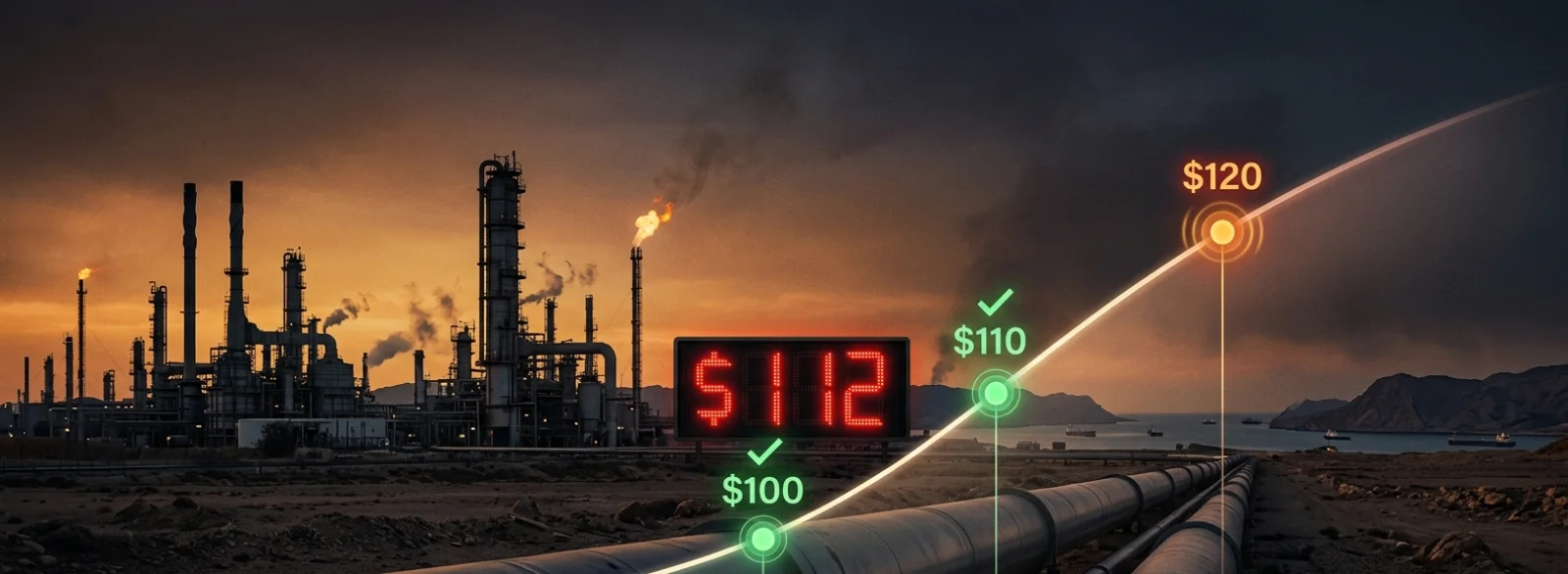
Where We Left Off
On March 17, when we published Anatomy of a War Premium, Brent was at $82. The prediction market probability curve had $100 oil at 78%, $110 at a coin flip, $150+ largely priced out. Hormuz was closed under Iran's selective passage policy (blocking US/Israeli allies, allowing Chinese and Indian tankers). Russia had a 30-day sanctions waiver. The US was debating naval escorts.
Three weeks later, those March markets have all resolved. The $100 market resolved YES at $16.6M in volume. Then Trump's April 2 war speech and a 48-hour Hormuz ultimatum pushed front-month Brent to $112. The June prediction curve has migrated into territory that looked like panic three weeks ago — while the actual June futures contract sits at ~$98 in backwardation. That dislocation between prediction markets and the futures curve is what we're breaking down here. Full data on our oil dashboard.
March 18: The Strike That Changed the Calculus
One day after our first article published, Iran struck Ras Laffan — Qatar's largest LNG processing complex and the single most important node in the global liquefied natural gas supply chain. Brent jumped from $82 to $91 in a single session.
The Ras Laffan strike did something the Hormuz closure alone hadn't: it decoupled the LNG crisis from the oil crisis. Before March 18, traders were pricing a single “energy disruption” event. After the strike, Asian LNG spot prices spiked 140% — a separate, compounding shock running parallel to the oil supply disruption. Two crises, not one.
For prediction markets, this created a problem. The existing oil threshold markets on Polymarket were denominated in WTI crude (CL), not LNG or Brent. Traders watching the LNG spike had no direct way to express that view in prediction markets. The $9 overnight move in Brent showed up as a muted signal in WTI-denominated contracts, because WTI's exposure to Hormuz disruption is structurally lower than Brent's. The prediction market probability curve was tracking the wrong benchmark.
The Brent-WTI spread initially widened to ~$5/bbl after Ras Laffan (Brent premium, up from the typical $2-3) as Middle East supply fears hit Brent harder. But by early April the spread had inverted — WTI is now trading above Brent by ~$2, an unusual dislocation reflecting the structural bottleneck in US export capacity and domestic refining demand. Polymarket's oil markets reference WTI (CL), not Brent.
The 400 Million Barrel Release That Didn't Work
On March 19, the IEA announced the largest coordinated emergency oil release in history: 400 million barrels from strategic reserves across 31 member nations, plus an additional 172 million barrels from the US Strategic Petroleum Reserve. The combined 572 million barrels represented roughly 20 days of Strait of Hormuz flow at pre-war rates.
Brent dropped from $91 to $88. Three dollars. On a 572-million-barrel announcement.
The prediction markets were even less impressed. The $100-by-March market barely moved. The June $100 threshold held steady. The market had already done the math: 20 days of coverage doesn't solve a structural closure. The IEA release was a bridge, but nobody could see what was on the other side.
In the first 10 days of the war, every headline moved the probability curve — a sanctions waiver moved $100 oil by 19 percentage points in a day. By March 19, the largest supply intervention in history produced a $3 dip. The market was no longer pricing individual events. It was pricing duration.
The Math Problem
The release has already been nearly exhausted on a duration basis. This is why it didn't move markets.
The Path from $82 to $112
Every major event from March 17 to April 5, mapped to front-month Brent. Steady grind from $82 to $103 through late March, then a violent repricing to $112 after Trump's April 2 speech.
Oil at $82. Markets still debating whether $100 was possible by end of March.
Qatar's largest LNG complex hit. Asian LNG spot prices spike 140%. Energy markets decouple — LNG crisis becomes separate from oil crisis.
Largest emergency release in history. Combined with 172M barrels from US SPR. Markets barely flinch — the release covers ~20 days of Hormuz flow.
Canada's largest refinery files emergency transport exemption. Physical supply chain breaking — Saudi crude completely cut off.
Front-month Brent breaches $100. Polymarket $100-by-March market climbs to 39%. Prediction markets had been pricing this as a coin flip for two weeks.
Trump promises domestic production surge. Brief 4% dip. Markets recover within hours — traders discount the tweet as non-actionable.
The 30-day Russia sanctions waiver expires. WTI touches $100 — the $16.6M March $100 market resolves YES. March $105 and above all resolve NO.
IEA chief Fatih Birol calls this "the biggest disruption in history" and warns April will be "much worse than March." OPEC+ begins a token 206K bbl/d increase.
Trump addresses the nation: war "nearing completion," but vows to hit Iran "extremely hard." Brent surges 8.1% to $109.35. WTI jumps 12.9%. A Hyperliquid trader is liquidated for $17M.
Trump gives Iran 48 hours to reopen Hormuz or "all Hell will reign down." Iran's military rejects it as "helpless and stupid." Brent hits $112.42.
Trump backs off ultimatum as mediators from Pakistan, Turkey, and Egypt engage. Front-month Brent at ~$109, but WTI June delivery (CLM26) in steep backwardation at ~$98. Prediction markets price a 78.5% chance WTI touches $120 before June. Ceasefire by April 30 at just 17.5%.
Through late March, each dip was shallower than the last — the Trump tweet on March 27 produced a 4% dip that reversed in hours. Then April 2 broke it: 8.1% single-session move in Brent, largest since Ras Laffan. The “markets have adapted” thesis lasted five days.
$100 Oil: Resolution
On March 24, front-month Brent crossed $100/bbl. By March 30, WTI itself touched $100 — and the Polymarket $100-by-March market resolved YES at $16.6M in volume. The market that started at 78% in our first article, dropped to 39% as March ran out, then surged to 100% in the final days.
But $100 turned out to be the floor, not the ceiling. Here's how every March threshold resolved — and the line at $105 tells you exactly where the market peaked before the April escalation:
March Oil Threshold Markets — Final Resolution
| Threshold | Price | Volume | Status |
|---|---|---|---|
| $75 HIGH | YES | $1.3M | YES — oil hit $75 |
| $80 HIGH | YES | $3.1M | YES — oil hit $80 |
| $90 HIGH | YES | $5.4M | YES — oil hit $90 |
| $95 HIGH | YES | $4.3M | YES — oil hit $95 |
| $100 HIGH | YES | $16.6M | YES — $16.6M traded on the question of the war |
| $105 HIGH | NO | $6.7M | NO — WTI peaked below $105 |
| $110 HIGH | NO | $8.0M | NO |
| $120 HIGH | NO | $8.0M | NO |
| $150 HIGH | NO | $9.5M | NO |
| $200 HIGH | NO | $12.5M | NO — $12.5M on the tail risk |
Source: Polymarket oil threshold markets (WTI CL). $75 through $100 resolved YES. $105 and above resolved NO. See all oil markets on our oil dashboard.
The line is clear at $105. Everything below resolved YES — oil hit those levels during the war. Everything at $105 and above resolved NO — WTI peaked below that level in March. The $100 market at $16.6M is the standout: the biggest single oil prediction market to resolve, and it answered the question that defined the first three weeks of the war.
But look at the NO side. $12.5M was traded on $200 oil by March — a tail risk that attracted massive speculative volume at 3-5 cents per contract. $9.5M on $150. These NO resolutions paid handsomely for traders who correctly assessed March's ceiling. But the June markets — which inherited all that fear — tell a very different story.
When Words Stopped Being Noise: March 27 vs. April 2
On March 27, Trump posted: “We will produce UNLIMITED ENERGY. American oil will flow like never before. Prices will come down FAST!” Brent dipped from $100 to $97 within 90 minutes. By noon, it was back at $99. The prediction markets barely flickered — a 2-percentage-point dip that reversed within an hour.
We wrote at the time that markets had learned to distinguish between actionable policy and social media posturing. That thesis lasted five days.
On April 2, Trump addressed the nation in a prime-time speech. He said the war was “nearing completion” but vowed to hit Iran “extremely hard” over the next two to three weeks. There were no concrete details about ending the war — no ceasefire terms, no diplomatic timeline, no Hormuz reopening plan. Markets were disappointed by the lack of substance, and they expressed it with price:
- Brent surged 8.1% to $109.35 — the largest single-session move since Ras Laffan on March 18
- WTI jumped 12.9%, closing at $111.54 — the June $110 market resolved YES in the aftermath
- The Dow dropped 600 points. S&P 500 fell 1.3%
- A single trader on Hyperliquid was liquidated for $17 million on oil perps
Two days later, Trump escalated further: a 48-hour ultimatum for Iran to reopen the Strait of Hormuz or “all Hell will reign down.” Iran's military called it “helpless and stupid.” Brent hit $112.42 — the highest since the war began. Then on April 5, Trump backed off as Pakistan, Turkey, and Egypt stepped in as mediators.
The March 27 tweet had no policy content — no executive order, no sanctions change, no military order. The April 2 speech committed to military escalation. The April 4 ultimatum set a deadline. Each had more policy content than the last, and each moved oil further. Markets aren't ignoring rhetoric — they're distinguishing tweets from policy.
Signal vs. Noise: What Actually Moved Markets
The pattern: markets discount rhetoric without policy content, but escalatory commitments move prices immediately.
The June Prediction Curve vs. the Futures Curve
Important distinction: these are threshold probability markets, not price forecasts. “$120 at 78.5%” means a 78.5% probability that WTI touches $120 at any point before June 30 — not that June delivery is priced at $120. The actual June futures contract (CLM26) is trading at ~$98, well below the $111 front-month spot price. The market is in steep backwardation — the futures curve expects prices to come down, but the prediction markets are pricing a high probability of another spike before they do.
Everything up to $110 has already resolved YES — WTI hit those levels. The live action is $115 and above. Here's the current curve from Polymarket's oil threshold markets:
June 2026 Oil Threshold Probability Curve
Source: Polymarket crude oil (CL) threshold markets, June 2026 expiry. Data as of April 5, 2026.
$120 at 78.5% is the base case. $130 at 59.5%. $150 at 25.5% with $901K in volume. Remember: the June futures contract itself (CLM26) is at ~$98. The prediction markets are pricing spike risk that the futures curve is not.
$200 tail risk at 9.5% has the most speculative volume at $1.64M. At ~10 cents per contract, it's 10-to-1 on the full-catastrophe scenario: Hormuz closed through summer, IEA reserves exhausted, no diplomatic offramp.
March vs. June: How the Probability Curve Shifted
| Threshold | March (resolved) | June (current) | Shift |
|---|---|---|---|
| $100/bbl | YES | YES | — |
| $105/bbl | NO | YES | +100pp |
| $110/bbl | NO | YES | +100pp |
| $120/bbl | NO | 78.5% | +78.5pp |
| $130/bbl | NO | 59.5% | +59.5pp |
| $150/bbl | NO | 25.5% | +25.5pp |
| $200/bbl | NO | 9.5% | +9.5pp |
March = final resolution. June = current active price. The shift at $105-$110 is the starkest: March said NO, June already says YES. Track all thresholds on our oil dashboard.
At $105 and $110, March said NO and June already says YES. March's ceiling became April's floor. The Trump speech on April 2 pushed WTI past $110, resolving the June $110 market and repricing everything above it. The “ceasefire before oil hits $120” market at 7.5%: 1-in-13 chance diplomacy arrives before $120 does.
The Ceasefire Collapse: From 47% to 17.5%
Two days ago, we would have written about the ceasefire-by-April-30 contract as a coin flip at 47%. Today it's at 17.5% with $11.2M in volume. The 30-percentage-point collapse happened in two stages: first when the March 31 ceasefire resolved NO at $44.4M (the single most-traded market in this war), then when Trump's speech and ultimatum signaled escalation rather than de-escalation.
War & Geopolitical Markets — April 5 Snapshot
The dashboard has shifted dramatically since we first drafted this article. Two things stand out:
First, the leadership markets resolved. Khamenei is out as Supreme Leader — the $8.2M market resolved YES. Mojtaba Khamenei as successor resolved at 99%. This was the “succession crisis” scenario we flagged — and it happened. The regime changed, but the war didn't end. The political structure that created the war premium persists under new management.
Second, the ceasefire timeline has stretched far beyond April. Three scenarios from the current data:
- No April resolution (82.5%): The April 30 ceasefire at 17.5% says the market overwhelmingly expects the war to continue into May. Hormuz traffic returning to normal by April 30 is just 11.5%.
- Summer ceasefire coin flip (45.5%): The June 30 ceasefire is the new coin flip, replacing April 30 in that role. If you believe in a June ceasefire, oil probably retraces to $90-95.
- $120 oil before any ceasefire (92.5%): The most striking market is “ceasefire before oil hits $120?” at just 7.5%. The market gives a 92.5% probability that $120 oil arrives before any diplomatic resolution. That's the strongest directional signal in the entire dashboard.
The $44.4M March 31 ceasefire market resolved NO — the single most-traded market in the entire war. Its resolution was the catalyst that dragged April 30 from 47% down to 17.5%. Watch the April 7 market ($10.3M volume, 0.85%) for the next NO resolution, which should further compress the remaining ceasefire timeline.
Hyperliquid: Where Oil Became Crypto's Biggest Trade
Hyperliquid's oil perpetual futures have exploded since our first article. The BRENTOIL-USDC contract does $977M in daily volume with $515M in open interest. WTI daily volumes have exceeded $1.2 billion. On April 2, a single trader was liquidated for $17 million when the Trump speech spiked prices.
One notable dislocation: the WTI perp ($111.54) is trading above the Brent perp ($107.19). The traditional Brent premium has inverted. These are perpetual futures — they track spot-like index prices, not delivery contracts. The actual June delivery contract (CLM26 on NYMEX) is at ~$98, reflecting steep backwardation. The perp-to-delivery spread is another way to see how much spike risk is being priced into the prompt month.
Hyperliquid Oil Perpetual Futures — April 5, 2026
Note: Perpetual futures (no delivery). WTI perp trading above Brent — the traditional spread has inverted. June delivery CLM26 at ~$98, steep backwardation. Positive funding = longs paying shorts = market skewed bullish. The +0.041% WTI funding rate means longs are paying a growing premium to maintain positions — up from +0.023% days ago.
What changed since our last snapshot:
- Funding rates have nearly doubled. WTI funding at +0.041% and Brent at +0.038% are up from +0.023% and +0.018% just days ago. The market isn't just bullish — it's getting more aggressively long. During the March 9 panic, rates hit +0.1% to +0.3%, so we're not at panic levels yet, but the trend is unmistakable.
- Open interest exploded. Brent OI went from $8.7M to $515M. That's not a typo — oil on Hyperliquid went from a sideshow to the largest OI category on the platform. Binance has also launched oil perps with 100x leverage, compounding the liquidity.
- The $17M liquidation is the story. On April 2, a single trader was liquidated for $17 million on tokenized crude — a number that “rivals bitcoin liquidations,” per CoinDesk. This is the same population that trades on Polymarket. When crypto-native traders take $17M hits on oil, the prediction market prices have real conviction behind them.
Front-month WTI at $111.54, Brent at $107.19, the $120 threshold at 78.5%, and funding rates nearly doubled — all pointing the same direction. But the June delivery contract at ~$98 says the futures curve disagrees about where prices settle. That spread between prompt and deferred is the trade.
The Normal Keeps Moving
We almost titled this “From Panic to New Normal.” Then Trump gave a prime-time speech and the normal moved $12 higher in a day. The data across every oil prediction market we track tells a clear story:
- Markets distinguished tweets from policy — and policy hit harder. The March 27 “unlimited energy” tweet moved oil 2 percentage points for one hour. The April 2 speech with military commitments moved Brent 8.1%. The April 4 Hormuz ultimatum pushed it to $112. Prediction markets learned to weight words by their policy content — and when the policy was escalatory, the repricing was instant.
- The probability curve leapfrogged March. March $100 resolved YES at $16.6M. June $100, $105, and $110 all resolved YES. The live frontier is now $120 at 78.5%, $130 at 59.5%, and $150 at 25.5%. Levels that were tail risks three weeks ago are now base cases.
- Ceasefire hopes cratered. The April 30 ceasefire crashed from 47% to 17.5%. The June 30 ceasefire at 45.5% is the new coin flip. The “ceasefire before $120 oil” market at 7.5% is the most directional signal on any platform: $120 comes first.
- Regime change happened. The war didn't stop. Khamenei is out. Mojtaba Khamenei is the new Supreme Leader. The succession scenario that was priced at 54% resolved YES — but the war premium persists under new management.
- DeFi oil markets are no longer a sideshow. Hyperliquid Brent OI hit $515M with $977M daily volume. A $17M liquidation on tokenized crude rivaled Bitcoin wipeouts. The same population trading on Polymarket is now taking massive directional bets on Hyperliquid, and the funding rates (+0.041% WTI, up from +0.023%) confirm the lean is bullish and getting more aggressive.
The entire $100-$110 band has been resolved and paid out. The live action is $120 to $200. The market gives less than 1-in-13 odds that diplomacy arrives before $120 does. Meanwhile, the actual June delivery contract sits at ~$98 in backwardation — the futures curve and the prediction markets are telling two different stories about what happens next.
What to Watch Next
Ceasefire by April 30 (17.5%): Down from 47%. If it drops below 10%, the market has given up on April entirely. If mediators from Pakistan/Turkey/Egypt produce a framework, this is the contract that moves first.
June $120 oil (78.5%): The new base case. If it crosses 85%, the market is pricing $120 as a near-certainty and the question shifts to $130+. If it drops below 65%, something changed — either diplomacy or a massive IEA release.
Ceasefire before $120 oil (7.5%): The most informative single market. At 7.5%, the market says $120 arrives first with 92.5% confidence. If this rises above 20%, it means real diplomatic progress.
Trump's Hormuz deadline (April 6): The 48-hour ultimatum expires tomorrow. If Trump follows through, expect the June curve to reprice sharply higher. If he backs down (already signaled), the market will watch for the next escalation instead.
New market creation: Watch our trending page for new oil and war markets. Polymarket created 40+ markets in the first 72 hours of this war. Each new escalation produces new contracts worth tracking.
Methodology & Data
This analysis uses price data from Polymarket oil threshold markets (WTI CL, March and June expiry), Polymarket geopolitical markets (ceasefire, Hormuz, nuclear deal), and Hyperliquid perpetual futures (CL, BRENTOIL). Polymarket threshold markets ask whether WTI spot (CL continuous) touches a price level before expiry — they are not forecasts of the delivery price. Hyperliquid prices are perpetual swaps tracking a spot index, not delivery contracts. The actual June delivery futures contract (CLM26) trades separately on NYMEX and was at ~$98 as of publication. All prediction market prices represent the YES token price, where $1.00 = 100% probability. Volume figures are all-time totals per contract. Brent crude prices in the timeline are approximate front-month daily closes sourced from Reuters and Bloomberg. Data as of April 5, 2026. All data is from real-money markets, not editorial predictions.
More from PredictMarketCap
Track oil and war markets in real time
Every market in this analysis updates live on PredictMarketCap.