
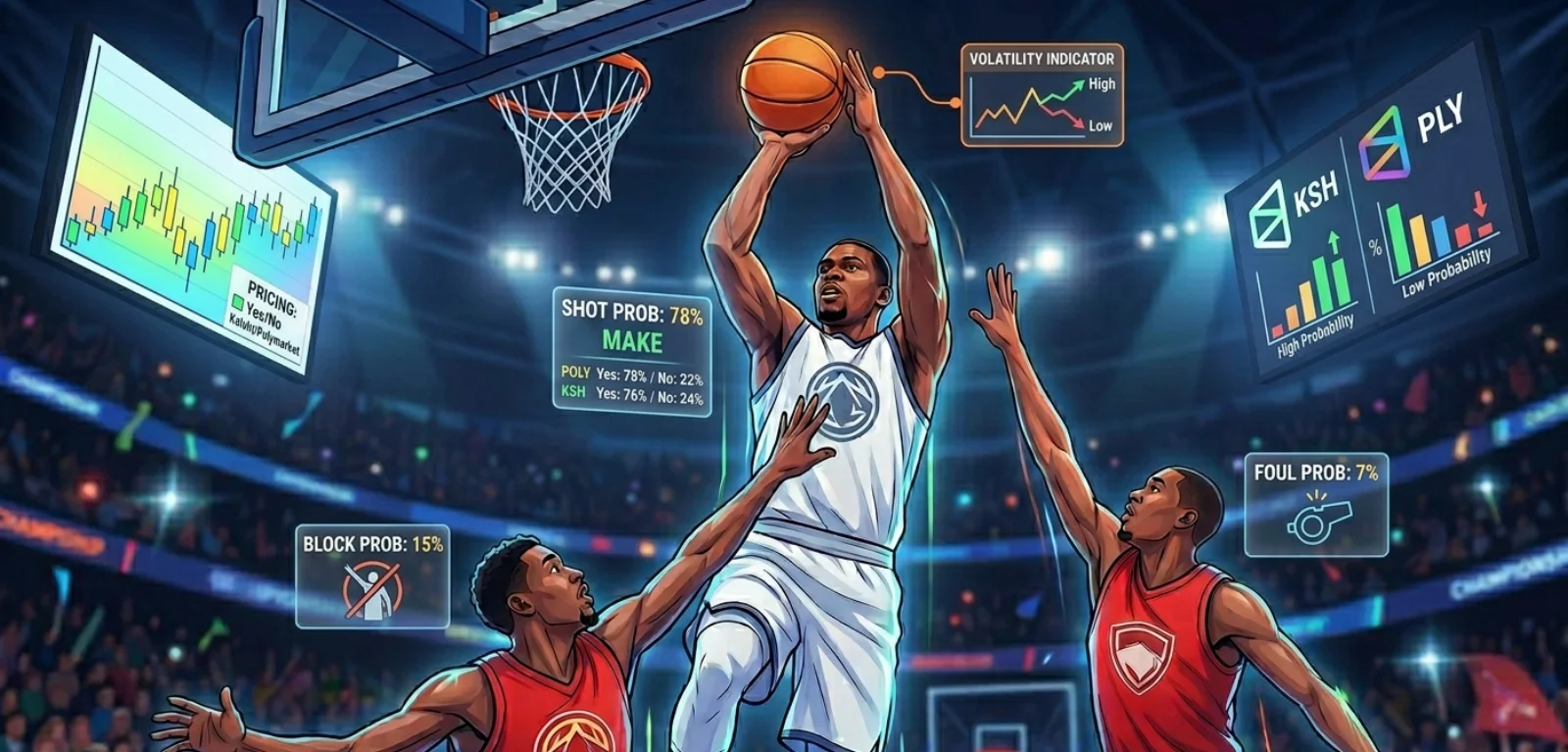
The $899,100 Victory Lap
During the Howard vs. Michigan first-round game on March 19, a Polymarket trader executed a single transaction worth $899,100. The position: Michigan — the No. 1 overall seed — to win, priced at 99.9%.
Why bet $899,000 on something the market says is 99.9% certain? Because prediction markets enable a strategy that doesn't exist in traditional sports betting: the victory lap. At 99.9%, the trader pays $0.999 per contract that pays out $1.00 when Michigan wins. Risk $899,100, profit roughly $900. A 0.1% return earned in hours.
Michigan won 101-80. Howard's 46 first-half points were the third-most ever by a 16-seed against a 1-seed, but Michigan's depth overwhelmed them in the second half. The $899K trader collected their ~$900 profit. Meanwhile, the same game attracted over $2.1 million in volume on Kalshi alone — multiple six-figure anonymous trades, all on the same matchup.
How the Victory Lap Works
Since 1985, a 16-seed has beaten a 1-seed exactly twice (UMBC over Virginia, 2018; FDU over Purdue, 2023). Victory-lap traders are selling insurance against the most unlikely outcome in sports — collecting small premiums that compound fast, with occasional catastrophic risk.
This isn't gambling in the traditional sense. It's the prediction market equivalent of picking up pennies in front of a steamroller — or, more charitably, it's a same-day money market for capital that would otherwise be sitting idle. The annualized return on a 99.9%-to-100% play, repeated daily, would be staggering. The risk is that the one-in-a-thousand upset happens on the day you have $899K on the line.
The $447K Conviction Bet — and the Biggest Comeback in Tournament History
If the $899K victory lap is the safe play, the most compelling whale trade in the entire dataset is the opposite: a $447,820 bet on VCU at 56% against sixth-seeded North Carolina.
This wasn't a victory lap. At 56%, the game was a toss-up. Someone put nearly half a million dollars on a genuine opinion about who would win — the kind of trade that only makes sense if the trader believes they have an edge the market hasn't priced in. A statistical model, a matchup insight, or just deep conviction about VCU's ability to compete.
What followed was extraordinary. North Carolina built a 19-point lead in the second half. VCU's win probability cratered. Then Terrence Hill Jr. caught fire — 34 points on 13-of-23 shooting, including a stepback three with 15 seconds left in overtime — and VCU completed the largest first-round comeback in NCAA tournament history, winning 82-78 in overtime.
Victory Lap vs. Conviction: Two Ways to Whale
On Kalshi, a different whale sold $190,000 of North Carolina at 95% — effectively betting against UNC as a heavy in-game favorite. When VCU completed the comeback, that position paid off handsomely too. The prediction market data shows real-money disagreement with the crowd — the kind of signal that makes these markets useful as forecasting tools, not just gambling venues.
The Full Whale Ledger: All 14 Six-Figure Trades
Here are every trade above $100,000 from the first round. Seedings are shown where known.
| # | Amount | Game | Position | Price |
|---|---|---|---|---|
| 1 | $899,100 | Howard vs. Michigan | BUYMichigan (1) | 99.9% |
| 2 | $447,820 | VCU vs. North Carolina | BUYVCU (11) | 56.0% |
| 3 | $247,500 | Howard vs. Michigan | SELLMichigan | 99.0% |
| 4 | $233,398 | Siena vs. Duke | BUYDuke (1) | 99.9% |
| 5 | $198,000 | Howard vs. Michigan | BUYMichigan | 99.0% |
| 6 | $190,000 | VCU vs. North Carolina | SELLNorth Carolina | 95.0% |
| 7 | $171,428 | Howard vs. Michigan | BUYMichigan | 99.0% |
| 8 | $159,752 | Howard vs. Michigan | BUYMichigan | 99.0% |
| 9 | $141,056 | TCU vs. Ohio State | SELLTCU Horned Frogs | 56.0% |
| 10 | $113,302 | Saint Louis vs. Georgia | SELLSaint Louis | 99.0% |
| 11 | $103,612 | Howard vs. Michigan | SELLMichigan (1) | 99.9% |
| 12 | $99,930 | Siena vs. Duke | BUYDuke | 99.0% |
| 13 | $84,000 | Kennesaw St. vs. Gonzaga | BUYGonzaga (1) | 94.0% |
| 14 | $73,100 | S. Florida vs. Louisville | BUYLouisville (3) | 81.0% |
A striking pattern: 5 of the top 8 trades are on the same game (Howard vs. Michigan), split across both platforms. And the majority of six-figure trades are victory laps at 94-99.9% — large capital collecting small premiums on favorites. The conviction bets at competitive odds (VCU at 56%, TCU at 56%) are the exception, not the rule.
Track whale trades in real time
$18.4 Million Across Two Platforms, 44 Games
The same games are being traded heavily on both Polymarket and Kalshi, with very different dynamics. Howard vs. Michigan alone generated $3.1 million in combined volume: $2.1M across 156+ anonymous Kalshi trades, and $1.1M on Polymarket dominated by the single $899K whale.
| Game | Combined |
|---|---|
| Howard vs. Michigan | $3.1M |
| Siena vs. Duke | $2.2M |
| VCU vs. North Carolina | $1.9M |
| S. Florida vs. Louisville | $1.4M |
| TCU vs. Ohio State | $1.1M |
| Kennesaw St. vs. Gonzaga | $904K |
| St. Louis vs. Georgia | $640K |
| Troy vs. Nebraska | $609K |
The transparency difference between platforms is stark. On Polymarket, every trade is tied to an on-chain wallet address. On Kalshi, every trade is anonymous — the platform is CFTC-regulated and doesn't publish trader identities. The same Howard-Michigan game generated $2.1M across 156 anonymous Kalshi trades; we can't tell if that's 50 traders or one whale placing 156 separate orders.
This creates an interesting information asymmetry. Polymarket whales are visible — you can see the $899K trade on our whale tracker, trace the wallet, and check their other positions. Kalshi whales are ghosts. For traders who care about privacy, Kalshi is the choice. For those who want to signal confidence (or who don't care), Polymarket's transparency comes with deeper liquidity and crypto-speed settlement.
Prediction Markets Are Rewriting Sports Betting
Traditional sports betting is fire-and-forget: place a bet, watch the game, win or lose. Prediction markets turn every game into a continuously traded asset. A trader who buys VCU at 56% before tip-off can sell at halftime if VCU takes a lead and the price jumps to 80%. The $899K Michigan trader could have exited mid-game if they got nervous. This is sports betting with a live secondary market — and it changes the risk profile fundamentally.
That's why six-figure trades on college basketball games aren't as reckless as they sound. The trader isn't locked in. They can hedge, exit, or double down as the game unfolds. For anyone with enough capital to care about flexibility, prediction markets are strictly superior to the traditional bookmaker model.
$18.4 million across 44 first-round games in 48 hours. Eight games with over $600K in volume each. A historic 19-point comeback that rewarded conviction capital and punished anyone who assumed North Carolina's lead was safe. And a $899,100 reminder that in prediction markets, even “guaranteed money” at 99.9% carries a sliver of existential risk.
The Sweet 16 starts this weekend. The whales will be watching — and so will we.
PredictMarketCap tracks live whale trades across Polymarket and Kalshi, updated every 5 minutes.
More from PredictMarketCap
Methodology & Sources
Trade data collected by PredictMarketCap from Polymarket and Kalshi public APIs, aggregated every 5 minutes. Volume and trade counts reflect a 48-hour window covering first-round games on March 19-20, 2026. Whale trades are individual transactions above $50,000.
Polymarket trade sizes represent actual USD cost (contracts × price), not notional contract counts. Kalshi trade sizes are calculated from contract count × yes price. Both represent actual capital deployed.
Game results verified against ESPN box scores. Kalshi trade outcomes are verified via platform resolution data (each market has an explicit outcome). Polymarket trade directions for 99%+ prices are inferred from game results and cross-referenced with Kalshi pricing on the same matchups. Competitive-priced Polymarket trades (e.g. 56%) are reported without directional claims where the data is ambiguous.
This article is not financial or gambling advice.