
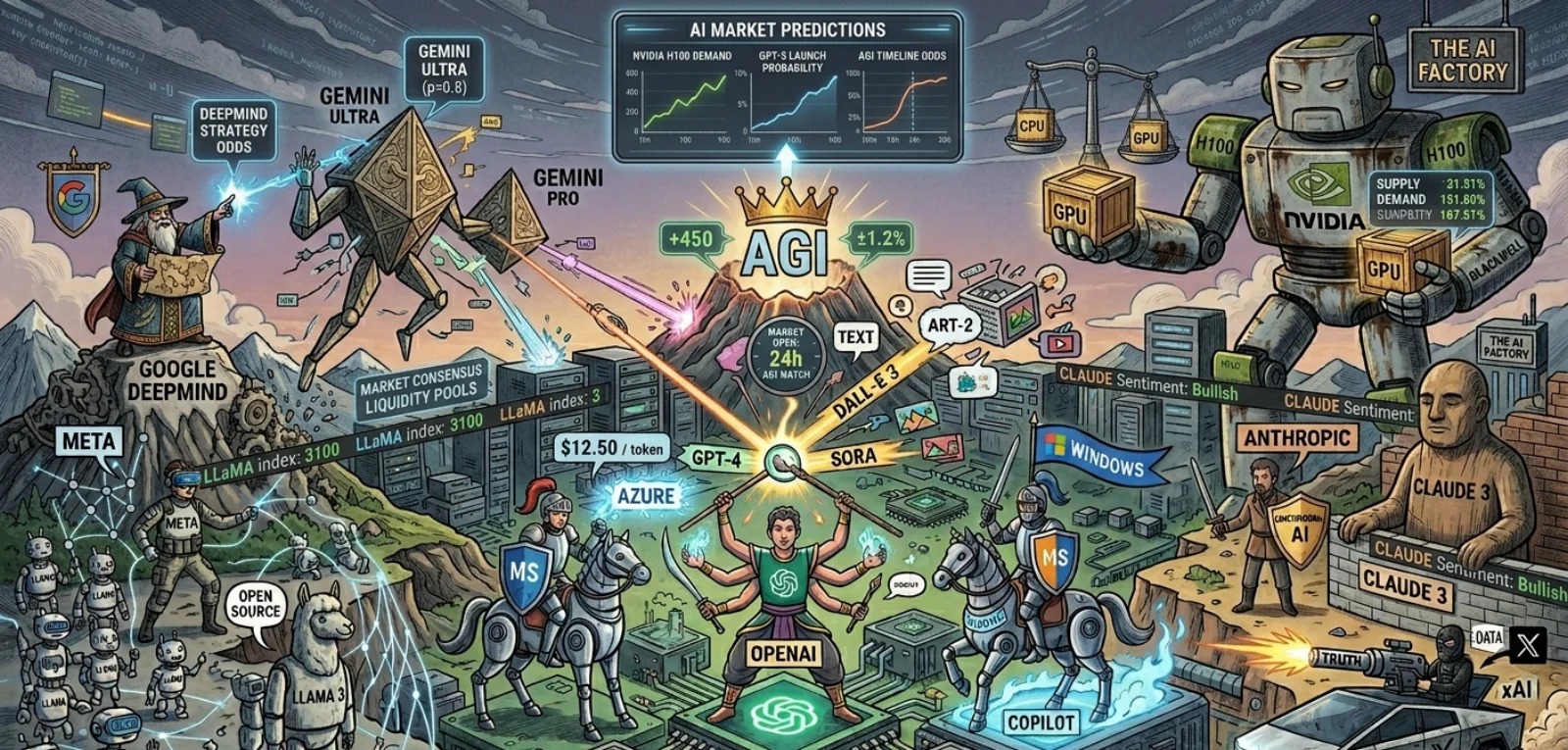
The Scoreboard: Who's Winning?
Both Polymarket and Kalshi run “Best AI model” markets — contracts that resolve based on which company's model has the highest score on the Chatbot Arena leaderboard, a crowdsourced Elo ranking where humans blindly compare model outputs. The leaderboard is checked on the last day of each month, and whichever model is #1 determines the winner. Traders put real money behind their predictions, and the resulting prices become probability estimates.
As of March 24, 2026, the picture is clear for the near term and surprisingly uncertain for the long term.
March 2026 — Not Even Close
Both Polymarket and Kalshi agree: Claude wins March.
Anthropic's Claude is priced at 97% on both platforms — one of the strongest cross-platform consensus signals we've seen. Every other contender is below 2%. This isn't a prediction; it's a verdict. Claude (likely Claude 3.5 Opus or its successor) is dominant right now.
But fast-forward three months and the picture shifts dramatically:
June 2026 — The Race Reopens
Polymarket odds for best AI model by end of June.
Anthropic drops to 57%, with OpenAI surging to 28% and Google close behind at 27%. The market is pricing in the near-certainty of new model releases from both companies. Three months is a long time in AI.
December 2026 — Anyone's Game
Kalshi odds for best AI by year-end.
By December, Claude is at 48% — still the favorite, but barely. Google's Gemini is the main challenger at 26%, followed by OpenAI at 14% and xAI's Grok at 11%. That's a combined 51% chance that someone other than Anthropic has the best model by year-end.
The Grok gap: Kalshi prices Grok at 11% for December, while Polymarket has xAI at just 5.2% for June. Kalshi bettors appear more bullish on Elon Musk's AI bet than Polymarket's crypto-native traders. An interesting divergence worth watching.
The Release Calendar: When Do New Models Drop?
The race doesn't just depend on who's ahead today — it depends on what ships next. Prediction markets offer a uniquely precise view of release timelines, with traders pricing specific deadlines based on insider signals, company behavior, and leaks.
| Model | Deadline | Probability |
|---|---|---|
| GPT-5.5 | June 30 | 89.3% |
| GPT-5.5 | April 30 | 58% |
| GPT-6 | Before GTA VI | 58.5% |
| GPT-6 | June 30 | 21% |
| Claude 5 | April 30 | 21.5% |
| Claude 5 | March 31 | 3.6% |
| Gemini 3.5 | June 30 | 39.5% |
| Gemini 3.5 | May 31 | 26% |
| DeepSeek V4 | March 31+36pp in 24h | 4.9% |
Key takeaways from the release calendar:
GPT-5.5 is imminent. At 89% by June and 58% by April, the market strongly expects OpenAI's next major release within weeks. This likely explains why OpenAI's June “best AI” odds jump from near-zero (March) to 28%.
GPT-6 before GTA VI? This is one of the more entertaining markets on Polymarket: will OpenAI release GPT-6 before Rockstar Games releases Grand Theft Auto VI? At 58.5%, traders think it's more likely than not. GTA VI is expected July 2026. With $611K in volume, this isn't a joke market — it's a genuine release date signal with a memorable benchmark.
Claude 5 is further out than you might think. Only 3.6% chance by March 31 (which is a week away), and 21.5% by April 30. Given Claude's current dominance, Anthropic may not feel pressure to rush.
DeepSeek V4 alert: The March 31 deadline market spiked +36 percentage points in 24 hours — from under 5% to potentially significant. Something is moving in the Chinese AI lab, and the market noticed before the headlines caught up. This is prediction markets at their most useful: aggregating distributed information faster than traditional media.
The Business Side: IPOs, Acquisitions, and AGI
Beyond model quality, prediction markets are pricing the entire AI industry's future. The business markets reveal where smart money sees the industry heading.
IPO Watch
Acquisition Targets
If OpenAI does go public, the market thinks there's a 48% chance it clears a trillion-dollarmarket cap on day one — which would make it the largest IPO in history. But there's still a 66% chance the IPO doesn't happen at all in 2026.
Perplexity at 29.5% is the most interesting acquisition signal. That's nearly one-in-three odds that the AI search startup gets bought before 2027 — likely by a company that wants to compete with Google's AI search integration.
Macro Signals
The tech layoffs signal is striking: $7.5 million wagered at 88% confidence that 2026 will see more layoffs than 2025. Despite the AI boom, the industry is still contracting in headcount. The “doing more with fewer people” thesis is priced in.
And the AGI question: 32% chance that OpenAI announces they've created AGI before 2028. Not that they necessarily have — but that they claim it. Given Sam Altman's history of bold announcements, the market is pricing in the marketing event as much as the technical milestone.
The Physical AI Frontier: Tesla, Optimus, and Robotaxis
The AI race isn't just about chatbots. Prediction markets are also pricing the physical AI revolution — and the bets reveal deep skepticism about Elon Musk's most ambitious timelines.
Optimus at 28% is probably the most generous reading of Musk's timeline — he's promised humanoid robots would be in production “next year” for three years running. The market is giving him roughly one-in-four odds of actually delivering this time.
Robotaxis in California by June is at just 14.5%. The Tesla-xAI and Tesla-SpaceX mergers hover around 10% each — low probability but enough volume to suggest the market takes the possibility seriously.
What the Market Is Really Saying
Step back from the individual numbers and a coherent narrative emerges:
- Anthropic won this round. Claude's 97% for March is as close to certainty as prediction markets get. This isn't controversial — it's consensus.
- The next 6 months will be chaotic. A 49-point drop from 97% (March) to 48% (December) reflects the market expecting multiple major releases from OpenAI, Google, and possibly DeepSeek to reshuffle the deck.
- OpenAI's comeback is priced in — but not a sure thing. GPT-5.5 is nearly certain by mid-year, and GPT-6 might beat GTA VI. But even with both releases, OpenAI only gets to 14% for best-by-December. The market respects the model but is skeptical it leapfrogs Claude.
- AI is booming but jobs aren't. The 88% tech layoffs signal alongside massive AI investment suggests the market sees AI replacing, not augmenting, human workers in the near term.
- China is a wildcard. The DeepSeek V4 spike shows how quickly the race can shift. A single Chinese lab release can move markets by 36 percentage points in a day.
PredictMarketCap tracks live AI model odds across Polymarket and Kalshi, updated every few minutes.
Methodology
All prices reflect prediction market odds as of March 24, 2026. Both Polymarket and Kalshi prices represent the probability of a “Yes” resolution.
“Best AI” resolution: Both platforms resolve based on the Chatbot Arena LLM Leaderboard (lmarena.ai), a crowdsourced Elo ranking with over 5.6 million human votes across 330+ models. Markets use the “Arena Score” with style control off, checked on the last day of each month — Polymarket at 12:00 PM ET, Kalshi at 10:00 AM ET. Polymarket resolves by company (whoever owns the top model), Kalshi resolves by specific model name.
Why 97% and not 100%? Claude holds both #1 and #2 on the leaderboard right now, but a new model could launch before the month-end snapshot. The remaining ~3% reflects that risk, plus the practical reality that pushing a price from 97% to 99.9% means risking $99.90 to win $0.10 — poor capital efficiency for a multi-day lockup.
Volume figures represent total money wagered since market creation, not current open interest.
FAQ
How do prediction markets determine which AI is "best"?
Markets like Polymarket and Kalshi use third-party benchmarks (typically lmsys Chatbot Arena or similar) to resolve "Best AI" markets. Traders buy and sell shares based on their assessment of which model will top the benchmark at the resolution date.
Why is OpenAI only at 14% for December when they have the most users?
Prediction markets price model quality based on benchmarks, not user count. The market appears to believe that Anthropic and Google will maintain competitive advantages on model capabilities through 2026, even as OpenAI remains commercially dominant.
Can you actually bet on AI model releases?
Yes. Polymarket and Kalshi offer markets on specific release dates for models like GPT-6, Claude 5, Gemini 3.5, and DeepSeek V4. These markets attract significant volume — the Claude 5 March deadline alone had nearly $1M wagered.